
Mesa County Crime News Sources
MCSO CRIMEWATCH sits at the official layer. The Sheriff's office posts alerts, selected arrests, wanted notices, and case updates there, though on no fixed schedule. A photo may accompany a post. It is never the full booking picture. Grand Junction Police fills another gap with a near-daily blotter covering arrests and notable crimes from the prior 24 hours, giving timing and incident context in plain text rather than working as a mugshot gallery.
For countywide scope, turn to the Mesa County Detention Facility booking summary. MCDF takes custodial arrests from agencies across the county, so its daily PDF covers more than either agency's own narrative. It has no photos. Fruita points readers toward weekly patrol summaries. No stable rolling arrest log for Palisade could be confirmed. These gaps matter. A city summary might list a citation that never led to jail, while a county booking can be missing from Sheriff activity reports when another agency made the bust.
Local newsrooms pick and choose from there. JunctionNow runs the only verified weekly countywide feature built around supplied booking images. KKCO, KJCT, WesternSlopeNow/KREX, and the Daily Sentinel each report selected incidents, investigations, and court matters. Treat all of them as coverage, not as a complete arrest database.
Mesa County Outlets Compared
Every outlet here works differently. Cadence, source mix, and photo policy all vary. An agency release carries official weight, but it still deserves a check against the filed court record before you treat any detail as settled.
| Outlet | Coverage | Photos? | Where |
|---|---|---|---|
| MCSO CRIMEWATCH | Irregular Sheriff alerts, wanted posts, selected cases | Selected images | Official agency feed |
| GJPD Police Blotter | Preceding-24-hour arrests and significant reports | No gallery | Official city blotter |
| MCSO Booking Summary | All-agency MCDF bookings in a daily window | No | Official county report |
| JunctionNow | Weekly Jail Bookings plus local news | Recurring supplied portraits | Unofficial local publication |
| KKCO 11 News | Selected Mesa County and city crime stories | Sometimes agency supplied | Event-driven crime section |
| KJCT 8 | Selected local investigations and arrests | Sometimes agency supplied | Event-driven crime section |
| Daily Sentinel | Western Colorado crime and court reporting | Varies by story | Selected reports, not a booking gallery |
| WesternSlopeNow/KREX | Western Slope local events | Selected suspect images | Event-driven local news |
The KKCO crime page shows the selective, event-driven pattern.
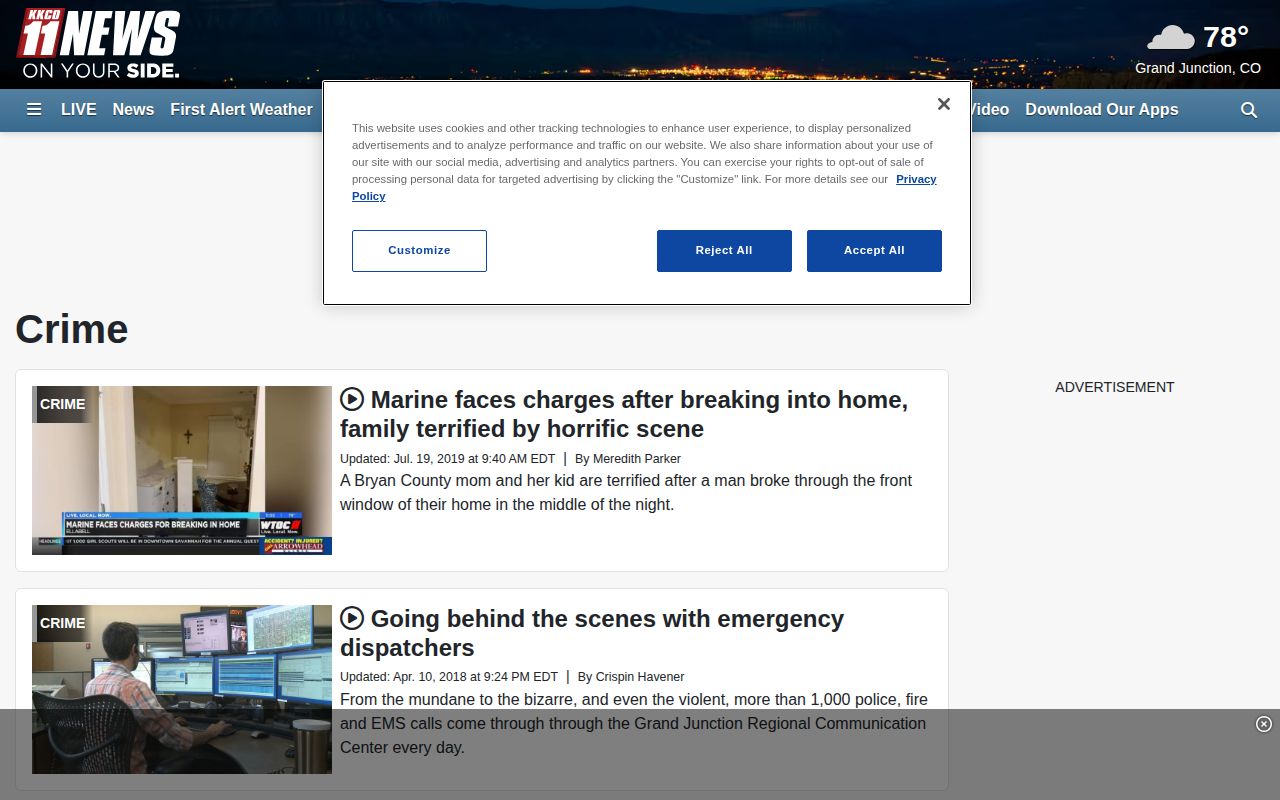
This page helps with current context. It cannot replace the county booking report or the court file for anything that matters.
Mesa County Weekly Booking Features
JunctionNow's news section runs a recurring "Weekly Jail Bookings" feature. The April 2026 edition is typical. It appeared the Sunday after the stated week. Each entry showed a supplied portrait, a name, an age, a booking time, and charge or statute descriptions. The publisher credits the Mesa County Detention Center and cites C.R.S. § 24-72-304 as its source. That chain is clear. Still, the article itself is not an official county record.
One caution belongs beside any citation of the feature. JunctionNow warns that an entry can reflect an older case, a transfer, or a records update. It may not be a fresh incident at all. The feature can also mix bookings from Grand Junction, Fruita, and Palisade, since all three cities route custodial intake through the shared jail. The representative weekly booking article shows the format and carries that status warning.
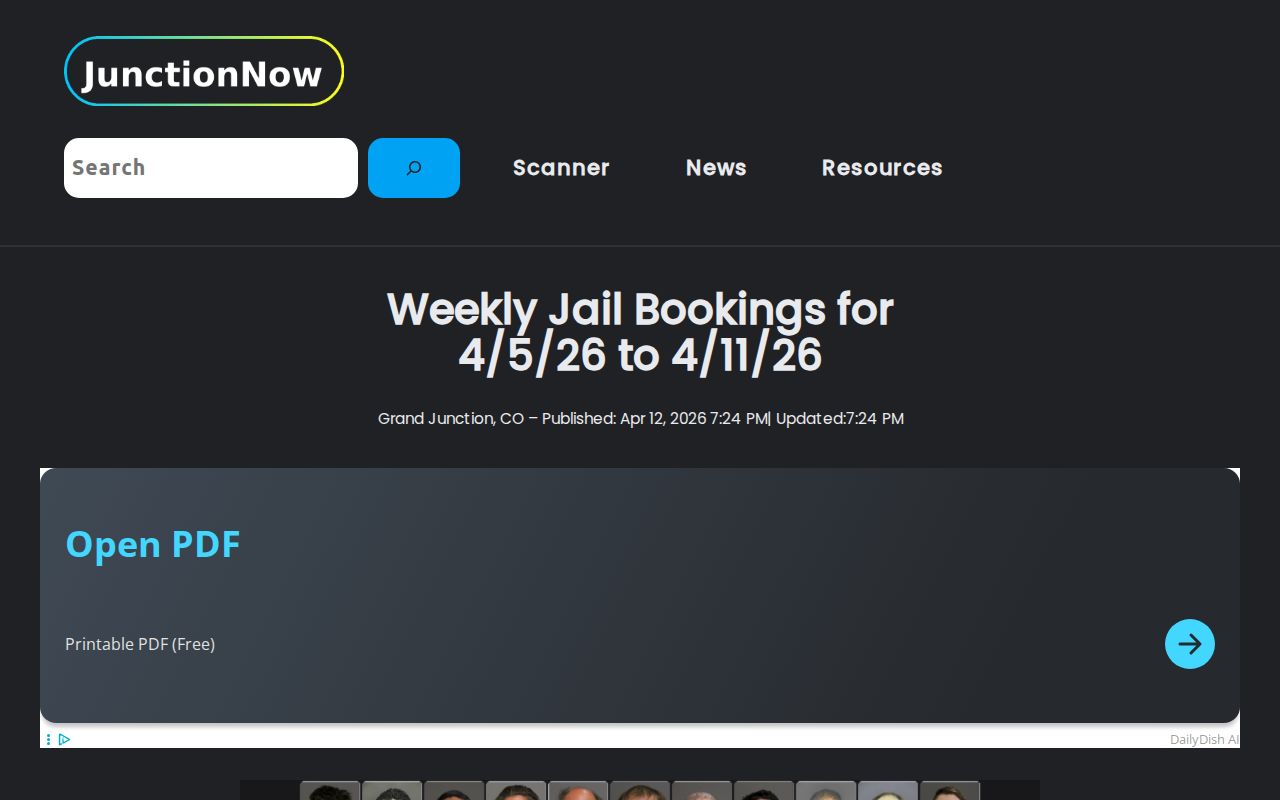
The screenshot here offers publication context only. It is not a hosted booking gallery. For the real thing, go on to the MCSO and court sources.
How Mesa County Photos Reach News
Start with what the Sheriff actually publishes. MCSO's public booking PDFs hold text fields and charges but no mugshots. The public locator promises no image either. Instead, the office treats booking photos as a $3 records product, with a separate PIO route for media during business hours. A reporter can get an image through a release or a request. Everyone else goes through the signed records process.
Colorado law shapes that pipeline too. Under C.R.S. § 24-72-305.5, a requester must affirm the image will not land on a site that charges money to take it down. The statute does not require photos to go online. Custodians can still apply juvenile, sealing, safety, privacy, and active-investigation limits.
News photos are selective. GJPD and MCSO releases sometimes attach an agency image for a notable case. KJCT, for instance, has credited MCSO mugshots in a Grand Junction story. A supplied visual could just as easily be a surveillance frame or suspect photo rather than a jail intake portrait. Read the caption and note the source.
Trace Mesa County News to Records
A story is a lead, not the finish line. The official record settles the source, the custody status, and the outcome. Search with the event date and exact identifiers instead of relying on a headline.
- Record the name, alleged incident date, arresting agency, location, and any case or booking number in the story.
- Check the MCSO Booking Summary for the applicable 24-hour period. This confirms MCDF intake, not guilt.
- Use the current Inmate Locator only to ask whether the person remains housed and to view the limited bond display.
- Read the arresting agency’s incident report or blotter. GJPD, FPD, Palisade Police, and MCSO keep different records.
- Search Colorado Judicial dockets, then request the register of actions or disposition order from the 21st Judicial District.
- Describe the outcome exactly. A dismissal, amendment, plea, acquittal, and conviction are not interchangeable.
The Mesa County busted mugshots and booking hub pulls it all together: the county feed, the roster, the photo-request path, and the court route. One quirk worth knowing. A live jail locator never explains why custody ended, while a dated news story can stay searchable long after the case has moved on.
Mesa County Alerts and City News
For breaking news, the sheriff's office relies on the CRIMEWATCH Mobile app. Wanted notices land there. So do new posts, selected arrests, and tips. It is not a booking-photo tool, though. No jail roster lives there either. The agency also runs Facebook, X, YouTube, and Instagram accounts with extra snapshots, but a shared post can miss a later update or correction, so trace anything back to the agency that posted it.
City coverage varies quite a bit. Grand Junction publishes a daily resume with the best local timing and narrative. Fruita's official route leads to weekly patrol resumes instead. There is no stable rolling archive like GJPD's. Palisade offers a police and Town records request as a fallback rather than a continuous public log. For a fuller picture of how the split works, the Grand Junction busted mugshots page lays it out in detail.
Colorado VINE sends custody-change notifications where available. Those cover release, transfer, escape, and other status updates. It is not a news-photo source. Is someone in immediate danger? Call 911 rather than posting a comment on an app or filling out a news contact form.
Mesa County Court Timing in News
News stories can outrun the court file. Colorado Criminal Rule 5 requires appearance without unnecessary delay. MCSO reports that bond hearings generally happen within 48 hours of booking. Neither source backs the stock claim that every Mesa County arrestee gets arraigned within 24 hours. So a story published right after intake may land before any advisement, charging decision, or bond ruling exists.
Three timestamps matter here. The publication time tells one story. The Booking Summary window tells another. The court docket adds a third view of where a case actually stands. A docket shows scheduled events only, while the register of actions or a disposition order gives the fuller result. When a correction or court outcome arrives later, it outweighs a first-day headline that never changed.
Unofficial Mesa County Record Sites
Third-party pages come after the Sheriff, police, and court because their data may be stale, incomplete, duplicated, or attached to the wrong person. One Mesa-local unofficial jail-roster page claims current status, charges, mugshots, and frequent updates but provides no visible primary support or public correction route. Treat it as low-confidence landscape evidence, not a recommendation.
No genuine Mesa County section was verified on the research date for Busted Newspaper, Recently Booked, Mugshots.com, Arrests.org, or Mugshots.zone. Recently Booked’s Colorado inventory can document that absence, but it must not be described as a Mesa page. Other county sections on commercial publishers show why old year filters and retained arrest data can outlive a case. Search one’s own name or track a known court matter through official records before trusting a copied profile.
Official sources still have limits. A county report is accurate to its stated window, and a roster reflects its current-custody scope. The difference is accountability: MCSO, a city police records unit, and the court can explain or correct the record they created. An unofficial page may not publish its source, refresh schedule, or correction practice.
Archived coverage also needs a date check. The county’s public report index rolls forward, but a news article can stay online for years. That article may preserve the first allegation even after a prosecutor changed the counts or a judge dismissed the case. Search the person’s court case by the correct jurisdiction and compare the register of actions with the article’s publication date.
When a report concerns a federal arrest, the Bureau of Prisons locator covers sentenced federal custody and publishes no inmate photo. A U.S. Marshals notice is a selected federal fugitive source, not the Mesa jail roster. Civil immigration detention belongs to ICE’s locator and is not proof of a criminal conviction. These distinctions prevent a local headline from being matched to the wrong system.
Public Record Search
Sponsored Results